18:58:36 8/5/2024 - 15 views
Laravel testing
In Laravel, it has 2 test types:
- Unit test
- Feature test
Unit test only focuses on a small piece of code (usually a method inside a class), while a feature test verifies if a particular feature, which may consist of multiple methods or classes interacting with each other, is working the way you designed.
Create tests
- Create a feature test
php artisan make:test UserTest- Create a unit test
php artisan make:test UserTest --unitGet started
To get familiar with the Laravel test, when you run one of the two commands above to create a test, Laravel will create a folder with the structure like this:
tests
___Feature
|___ExampleTest.php
|___UserTest.php
___Unit
|___ExampleTest.php
Okay, I can run this command to get started on the tests:
./vendor/bin/phpunitThe output will show the message that is well for all tests.
Now, I will edit something in UserTest.php:
public function test_example(): void
{
    $x = 1 + 1;
    $this->assertTrue($x == 3);
}If you run tests, you will receive an error at the test_example() function, because the result of the calculation is 2, it is not 3
Call API
There are 2 ways to send a request (call API):
1. withHeaders
$response = $this->withHeaders([
    'Accept' => 'application/json',
    'Content-Type' => 'application/json',
    'Authorization' => 'Bearer ' . $jwtToken,
])->json('POST', '/endpoint');

$this->assertEquals(200, $response->status());2. postJson
$headers = ['Authorization' => 'Bearer ' . $jwtToken];
$response = $this->postJson('/personal/upload-image-editor', [], $headers);
$this->assertEquals(200, $response->status());
Test dependencies
Usually, the testing will run from the top to the bottom ordering, but in the case your function is async and you want to ensure the order is exact, you can use @depends annotation.
For example, if you have a test with 2 cases:
- Create a user
- Delete the user just created
If you create 2 functions to do this, perhaps the delete method will run before the create method so you will receive an error.
To prevent this, PHPUnit supports test dependencies via the @depends annotation.
public function createUser(){}
/**
* @depends testEmpty
*/
public function deleteUser(){}The code above will ensure the createUser function will execute finished, after that, the deleteUser function will execute
Run tests
Run all tests:
php artisan testor
./vendor/bin/phpunitRun all tests and display details of the error if it has:
./vendor/bin/phpunit --testdoxRun a specific test file:
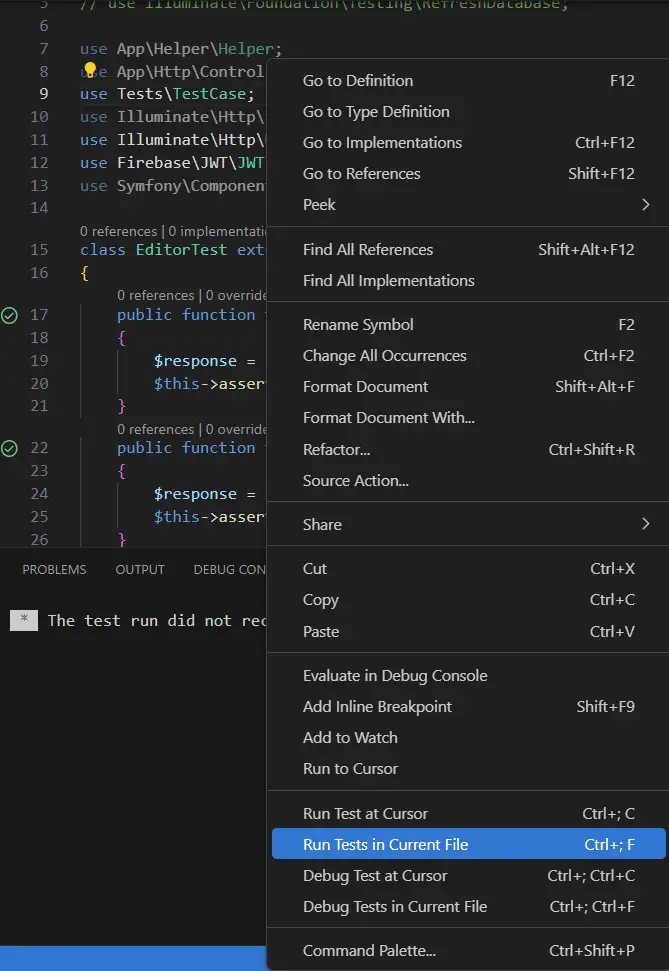
./vendor/bin/phpunit --testdox .\tests\Feature\UserTest.phpOr you can run directly in VS Code (Image 1)
Run a specific test file and a specific function:
./vendor/bin/phpunit --testdox .\tests\Feature\UserTest.php --filter createUserBut with the example above, if you want to run a specific function that depends on another function, it will be an error.
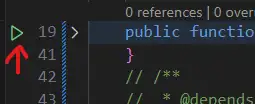
Or you can run a specific function directly VS Code (Image 2)
Get data from the response
For example, We call the API to the server that returns a JSON:
class myController{
	function test()
	{
		return response()->json(['message' => 'Hello']);
	}
}testing:
function test_get_message()
{
	$response = $this->postJson('/test');
	$this->assertEquals(200, $response->status());
	$res= $response->json();
	$message = $res['message'];
}Pass values between tests (function)
In PHPUnit, every test independent, meaning is the variables of every test (function) which will not be shared with each other.
To share the variables with each other, it must depend on using @depends, see the example following:
public function test_create_post()
{
	$id_post = 1;
	return $id_post;
}
/**
* @depends test_create_post
*/
public function test_delete_post_illegal($id_post): void
{
	//$id_post = 1
}
/**
* @depends test_create_post
*/
public function test_delete_post_legal($id_post): void
{
	//$id_post = 1
}
References
https://betterstack.com/community/guides/testing/laravel-unit-testing/